AI agents that work up to the limits you set.
They handle repetitive steps, then stop at the points you choose to ask for approval.
What is an AI agent?
An AI agent handles repetitive steps such as reading, summarizing, filling in, and classifying. At the points you choose, it stops and asks a person for approval before it continues.
Situations we often see
Common situations
- Incoming tickets or letters that have to be read, categorized, and forwarded by hand.
- Monthly reports compiled from several sources that take days to put together.
- Approval processes that stall because the paperwork is incomplete.
How we help
- Workflow mapping: which steps can be automated and which must stay with people.
- Agents that prepare drafts, fill in forms, match data, and flag data that looks unusual.
- Clear approval points: who approves, when, and with what information.
- An audit trail: agent actions are logged; corrections depend on what the connected systems support.
Your data, your rules
Before an agent starts working, we agree on the following.
- Which systems and documents the agent may access.
- Which actions it may take on its own and which need approval.
- Who approves, and how actions are logged.
- Which outside services may connect. Documents are not sent to third-party services without written approval.
How it works
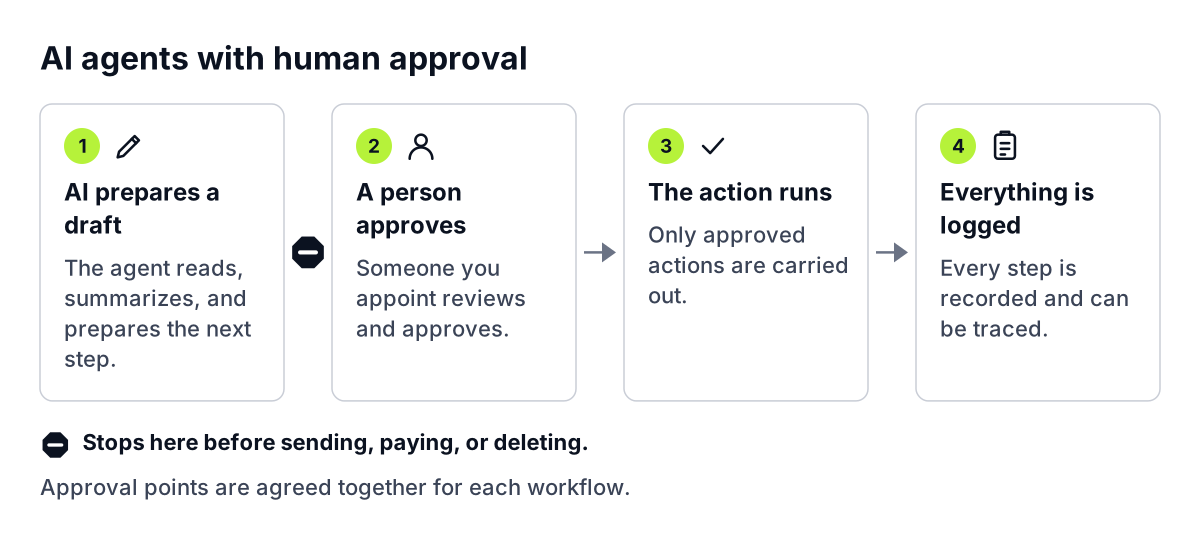
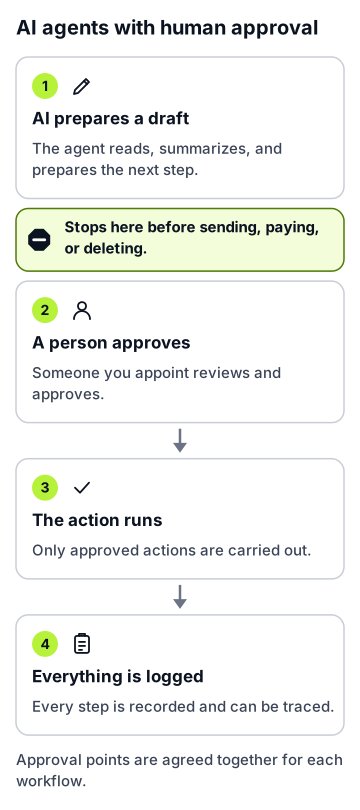
Text summary of the infographic
AI agents work with human approval. First, the agent reads, summarizes, and prepares the next step as a draft. It stops here before sending, paying, or deleting anything. Second, someone you appoint reviews and approves. Third, only approved actions are carried out. Fourth, every step is recorded and can be traced. Approval points are agreed together for each workflow.
- We map the workflow and set the approval points.
- The agent prepares a draft or a result.
- The assigned person checks and approves at the agreed points.
- The action is carried out and logged.
Limits
- Agents are not given authority to send, pay, or delete without human approval. This is our design decision, not an option.
- AI agents can be wrong, so their results are checked by the person responsible for the process.
- Correcting an action depends on what the connected systems support.
What we need to get started
- A process owner who can judge whether results are right or wrong.
- Real case examples (they may be anonymized).
- The approval rules that apply.
Ask about your needs
Start with a short question or a rough idea of the work you want to improve. No technical specification needed.
Email: info@sixseven.camp