
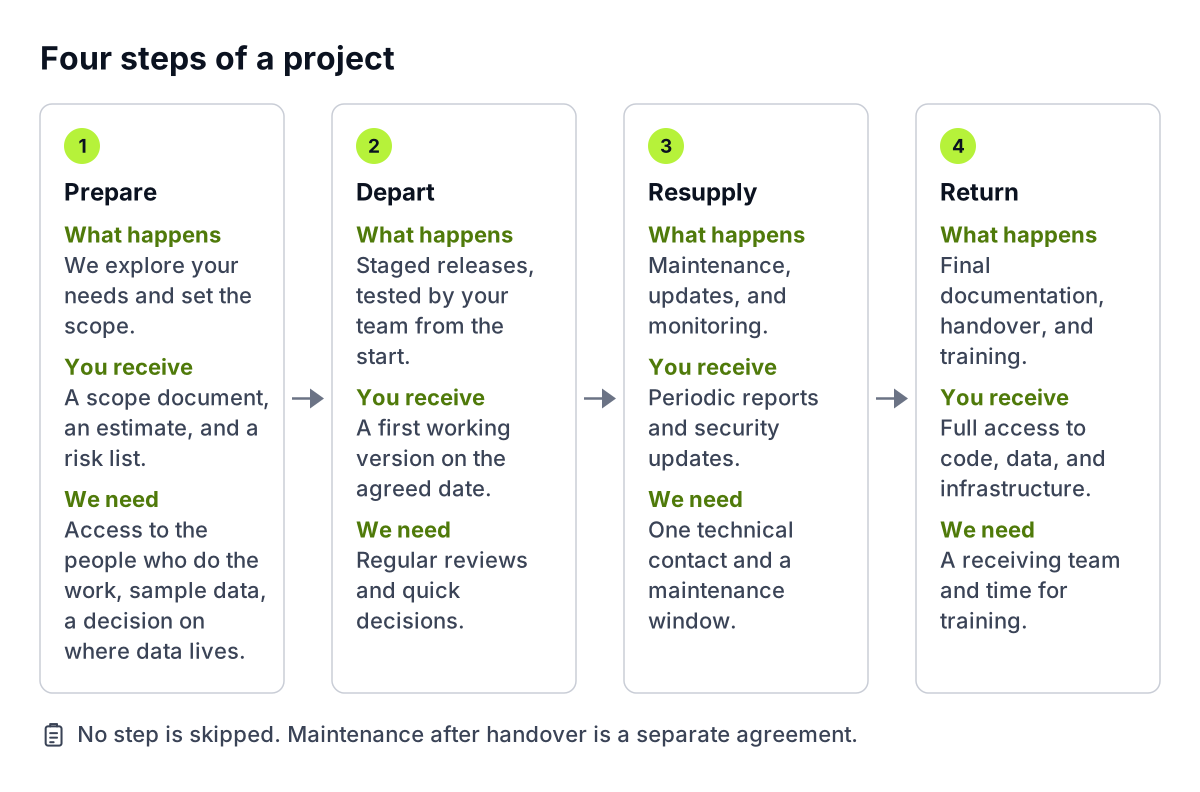
Four steps, always in this order.
A step can be short or long depending on the scope, but none is skipped.
Text summary of the infographic
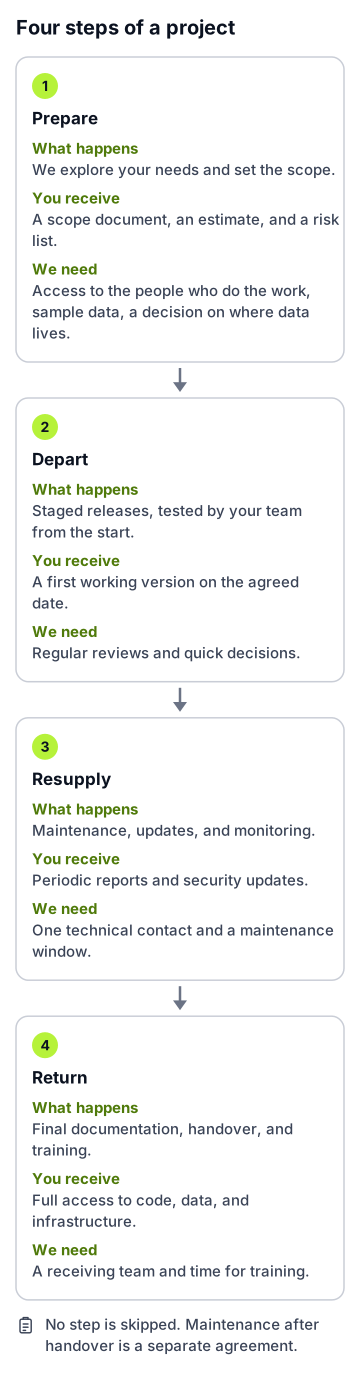
A project moves through four steps, always in this order. Prepare: we explore your needs and set the scope; you receive a scope document, an estimate, and a risk list; we need access to the people who do the work, sample data, and a decision on where data lives. Depart: staged releases tested by your team from the start; you receive a first working version on the agreed date; we need regular reviews and quick decisions. Resupply: maintenance, updates, and monitoring; you receive periodic reports and security updates; we need one technical contact and a maintenance window. Return: final documentation, handover, and training; you receive full access to code, data, and infrastructure; we need a receiving team and time for training. No step is skipped, and maintenance after handover is a separate agreement.
What happens at each step
1. Prepare
What happens: Discovery (talking with users, watching the real process), defining the scope, and an honest estimate that includes what we do not know yet.
What you receive: A scope document, a cost and time estimate with its assumptions, a list of risks, and one agreed first step.
What we need from you: Access to the people who run the process, sample data, and a decision on where the data will live.
2. Depart
What happens: Releases in stages; your team tests the first working version early; task board and repository are shared; regular reviews.
What you receive: The first working version on the agreed date, followed by further releases with change notes.
What we need from you: Regular reviews and quick decisions when the scope shifts.
3. Resupply
What happens: Maintenance, updates, refreshing AI models and integrations, monitoring.
What you receive: Regular reports, support as agreed, and security updates.
What we need from you: One technical contact and a maintenance window.
4. Return
What happens: A joint retrospective, final documentation, and handover, including training for your team.
What you receive: Complete documentation, full access to the code, data, and infrastructure, and training materials.
What we need from you: A designated receiving team, and time for training.
Can the work be done in stages?
Yes. We would rather deliver progress that works than make long promises.
Maintenance after handover is a separate agreement and is not required. After the Return step, your team can carry on alone; if you would like us to stay with you, we agree on that separately.
Data and security in the project
Text summary of the infographic
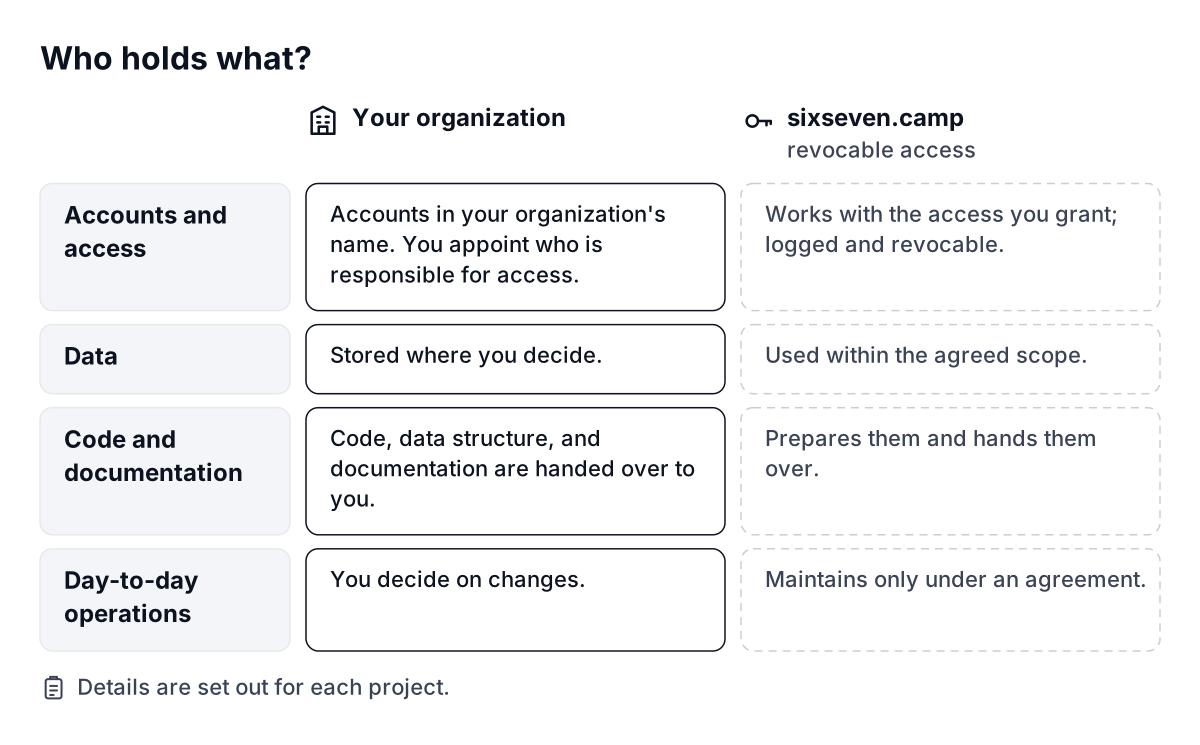
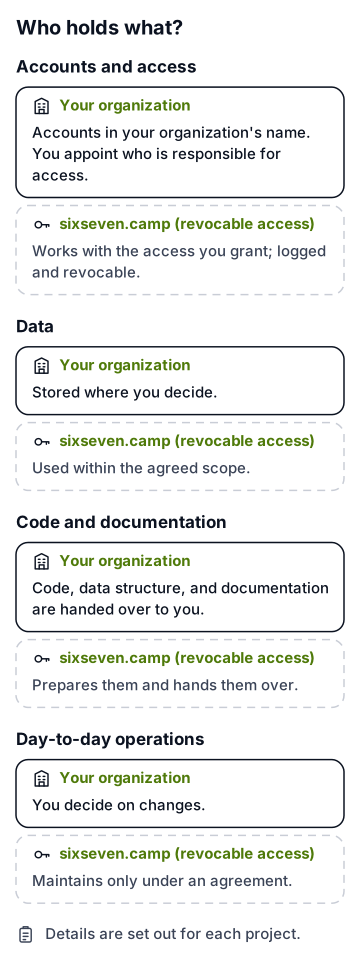
This table compares the roles of your organization and sixseven.camp, whose access can be revoked. Accounts and access: accounts are in your organization’s name and you appoint who is responsible for access; we work with the access you grant, which is logged and revocable. Data: stored where you decide; we use it within the agreed scope. Code and documentation: code, data structure, and documentation are handed over to you; we prepare them and hand them over. Day-to-day operations: you decide on changes; we maintain the system only under an agreement. Everything is set out for each project.
Security arrangements are set out in writing before work begins. What we usually apply is agreed per project:
- Where data is stored: you decide during Prepare, whether your own servers, a private cloud, or a cloud provider of your choice. Backups follow the main location.
- Access control: role-based, with accounts in your organization’s name. Our team’s access is logged and you can revoke it.
- Encryption: data is protected in transit and at rest; keys are managed in your environment.
- Logging: access and changes are recorded; retention follows your policy.
- Backup and recovery: the backup schedule is agreed; recovery is tested, not assumed.
- If an incident occurs: you are told in writing when it happened, its impact, the actions taken, and the expected recovery.
More detail is in Data, access, and control. The privacy policy for this site is in Privacy policy (Indonesian).
Ask about your needs
Start with a short question or a rough idea of the work you want to improve. No technical specification needed.
Email: info@sixseven.camp