
Ask your documents and get answers with their sources.
The assistant first finds the relevant parts of your documents, then builds an answer from them and names its sources.
What is Ask your documents?
This approach is called RAG (retrieval-augmented generation). In plain terms, the AI does not answer from memory alone. It first looks up the relevant parts of your documents, then writes the answer from those parts.
An example question: “What is the leave policy for contract staff?” The answer names the document and page it used, so it can be checked.
Situations we often see
Common situations
- SOPs, internal regulations, and manuals are scattered across hundreds of PDFs; people ask colleagues instead of the documents.
- New team members take a long time to learn where the rules on a topic are written.
- Answers from general-purpose AI sound convincing but do not match internal rules.
How we help
- Collecting and cleaning documents (PDF, Word, internal pages), with access rights that follow each document’s original rules.
- Answers that name the source document and page.
- Updates to documents, index, configuration, and evaluation; model training only when needed.
- Measurement: which questions are answered correctly and which are not yet.
Your data, your rules
Before documents are added, we agree on the following.
- Which documents may be used.
- Who may see which parts; access rights follow each document’s original rules.
- Where the index and the assistant run: your server or a private cloud.
- Which outside services may connect. Documents are not sent to third-party services without written approval.
How it works
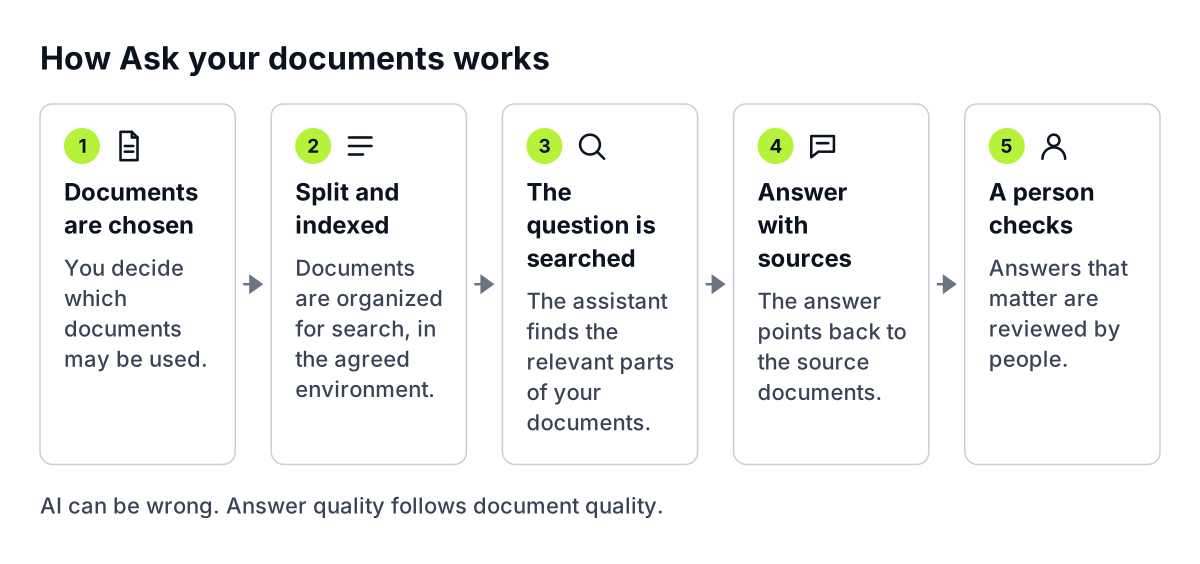
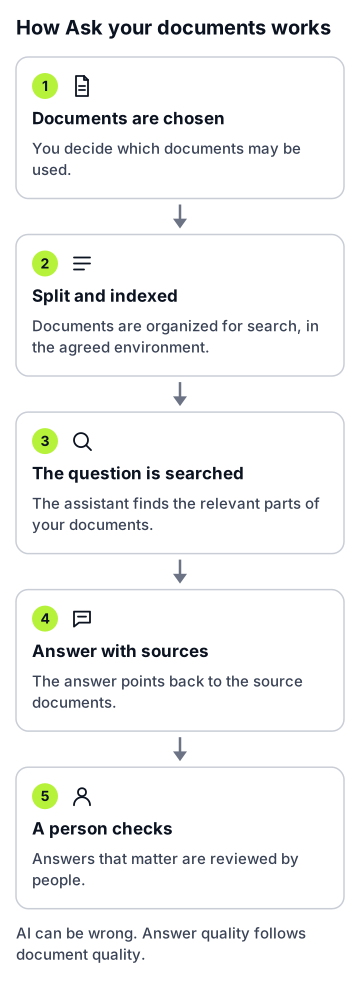
Text summary of the infographic
Ask your documents works in five steps. First, you decide which documents may be used. Second, the documents are split and indexed so they are easy to search, in the agreed environment. Third, when a question comes in, the assistant finds the relevant parts of your documents. Fourth, the answer is written with references to the source documents. Fifth, answers that matter are reviewed by people. AI can be wrong, and answer quality follows document quality.
- The documents you choose are collected and cleaned.
- The documents are split into small pieces and indexed so they can be searched quickly.
- When a question comes in, the assistant looks for the relevant pieces.
- The answer is built from those pieces, with the source document and page. A person checks it before it is used for a decision.
Limits
- Answer quality follows document quality.
- When documents contradict each other, the answer mentions both instead of choosing one on its own.
- AI answers can be wrong, so outputs that affect decisions are reviewed by people.
What we need to get started
- Documents in digital form.
- A list of who may see what.
- Examples of questions that come up often.
Ask about your needs
Start with a short question or a rough idea of the work you want to improve. No technical specification needed.
Email: info@sixseven.camp